An Indication That SPY Is Short-Term Overextended

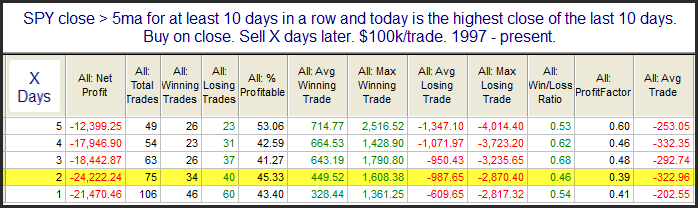
It has been a persistent move higher lately since the market bottomed mid-month. SPY has now gone 10 days without closing below its 5-day moving average (5ma), leaving it short-term overextended. The study below looks at other instances in which the market traded above the 5ma for at least 2 weeks and closed at a 10-day high.

2014-10-31 image1

In the past this setup has commonly been followed by a short-term pullback. The downside edge doesn’t last long, though. This seems to pretty much play itself out over the first 2 days. This study is one hint that the market is overdue for a bit of a pullback. As of last night I was still seeing more bullish evidence than bearish. With the big gap up this morning, it will be interesting to see whether a breakaway gap occurs and extends the rally further, or whether the short-term overbought nature of the market causes it to pull back as it often does.


Want research like this delivered directly to your inbox on a timely basis? Sign up for the Quantifiable Edges Email List.

What The Strong Breadth On Tuesday’s FTD Suggests

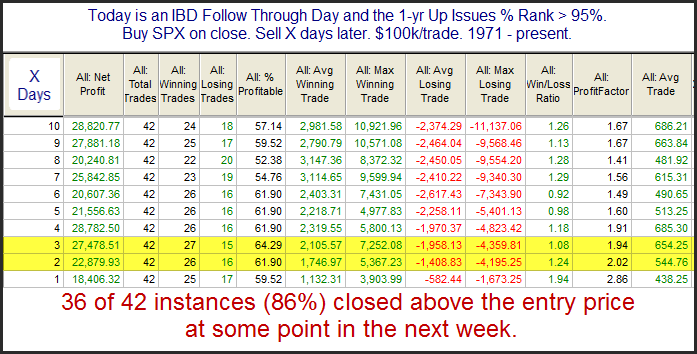
Over the years I have done a good amount of work quantifying IBD Follow Through Days (FTD). In the 8/24/11 blog I looked at the impact of breadth on FTDs. To compare breadth across market regimes, instead of using absolute breadth readings I use relative breadth readings. The study below uses the 1-yr Up Issues % Rank. This reading compares breadth versus all other days for the last year. Tuesday’s strong breadth placed it in the 99th percentile breadth-wise. This first table below looks at performance following FTDs that came along with an Up Issue % reading that was among the top 5% of all readings over the previous year. All stats are updated.

2014-10-22 image1

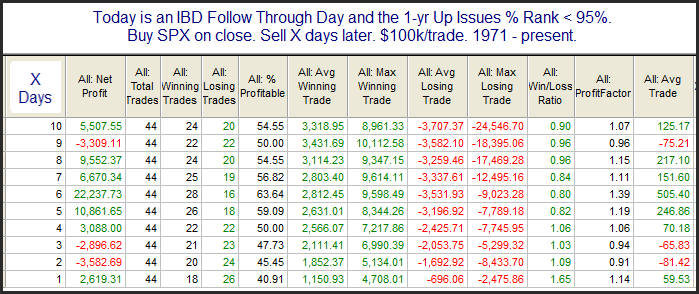
As you can see there appears to be a tendency for the market to continue higher after these strong-breadth FTDs. Now let’s examine performance after FTDs on days that did not show exceptional breadth strength.

2014-10-22 image2

As you can see, there is no discernible short-term edge here. From an intermediate-term perspective, I would also note that breadth seemed to play a part there as well. When the Up Issues % Rank was > 95% then 22 of 42 instances (52%) managed to post successful rallies. When breadth was not as strong on a FTD, then only 19 of 44 instances (43%) went on to successful rallies.

(Note: For purposes of all the FTD tests, a “successful rally” was defined as one that achieved the lesser of 1) twice the distance from the close of the Follow Through Day to the low of the potential bottom day, or 2) a new 200-day high.)


Want research like this delivered directly to your inbox on a timely basis? Sign up for the Quantifiable Edges Email List.
My Recent Tradestation Webinar Is Now Available On-Demand (Free)

A couple of weeks ago I did a webinar with the folks at Tradestation titled “Quantified Methods for Long and Short-Term Trading”. That webinar is now available for viewing at the Tradestation website. I have provided a link below. Enjoy!

https://www.tradestation.com/education/events/on-demand-webcasts/spotlight-on/rob-hanna-10-7-2014


Want research like this delivered directly to your inbox on a timely basis? Sign up for the Quantifiable Edges Email List.
What Persistently Weak SPY Closes Have Led To In The Past

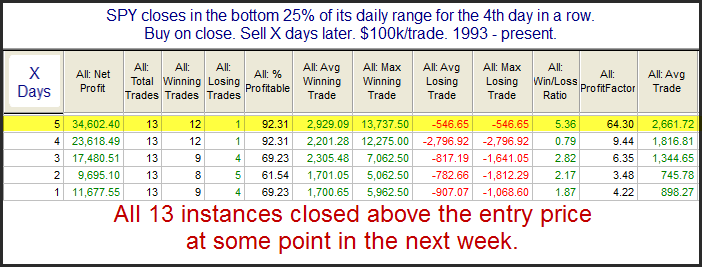
Despite attempts to put in rallies over the last few days, SPY has been persistently weak in the afternoon. It has not managed to hold gains and has closed in the bottom 25% of its daily range for the last 4 days in a row. That may not sound all that extreme, but it is pretty rare. Below is a look at how the market has performed following past occurrences. It looks back to the inception of SPY in 1993.

2014-10-15 image1

Instances are a little low, but the numbers are very lopsided in favor of the bulls. It will be interesting to see if the market can overcome its current funk and large gap down this morning to keep the string of short-term rallies alive.


Want research like this delivered directly to your inbox on a timely basis? Sign up for the Quantifiable Edges Email List.
Quantifiable Edges CBI Hits 12 On Monday – What That’s Meant For The Intermediate-Term

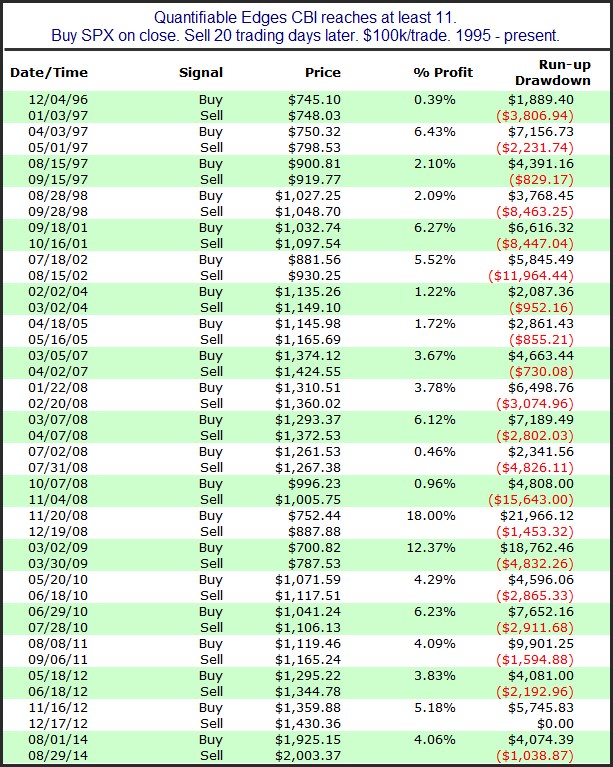
I’ve written an awful lot about the Quantifiable Edges Capitulative Breadth Indicator (CBI) here on the blog.  The CBI moved up from 7 to 12 on Monday.  While 10 has been a strong indication for a short-term bounce, 11 or higher has been a reliable indication for the intermediate-term. Monday was just the 22nd time the CBI reach as high as 11. Looking out 20 days later, every other instance has been trading higher. Below is the full listing of triggers and the 20-day results.

2014-10-14

As you can see, SPX has been a perfect 21=0 when looking out 20 days from the first CBI reading of 11+.  Drawdowns have been sizable in some cases.  Still, it appears a reading of this magnitude often suggests a washout is in progress that should set the stage for at least a multi-week bounce.  We may not reach the “final” bottom here, but this study indicates we should see at least a temporary bottom form soon.

Free Webinar Today – Quantifiable Edges for Short and Long-Term Trading

I am pleased to be able to say that I will be presenting a webinar this afternoon as part of Tradestation’s terrific “Spotlight On…” series. The topic is “Quantifiable Edges for Short and Long-Term Trading”. I’ll be discussing my approach to studying the market, some of my favorite timing methods, and how long-term indicators impact short-term timing performance.

The webinar is free. It will be held at 4:30pm EST this afternoon. To register you may use the link below:
https://tradestation.omnovia.com/register/33641409863723


Want research like this delivered directly to your inbox on a timely basis? Sign up for the Quantifiable Edges Email List.
Another Study Suggesting The Bounce Continues To Look Good

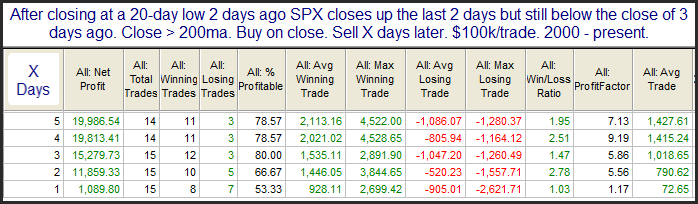
I showed on Friday that the “weak” bounce coming off the 20-day low was not something to be frustrated about. More evidence along those lines triggered Friday afternoon with the following study:

2014-10-06 image1

Instances are a little bit low here, but the stats are compelling. I’d also note that all 11 of the instances that closed higher 4 days later did so by over 1%. So the intermediate-term low has often been a nice launching pad. Of course not everything is pointing higher right now. So it will be interesting to see how things play out. But this one narrow view suggests the bounce could have further to go.


Want research like this delivered directly to your inbox on a timely basis? Sign up for the Quantifiable Edges Email List.
The Perfect Record Of A “Weak” Reversal From A 20-Day Low

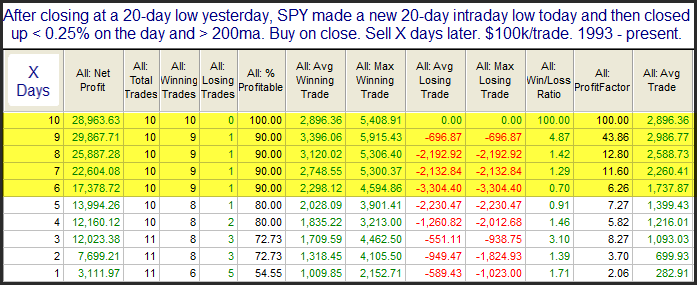
On Thursday SPY put in a big reversal after hitting a 20-day intraday low. Still, it only closed up a mere $0.03, barely qualifying as an “up day”. In the subscriber letter I examined other instances where this kind of reversal has taken place. I looked back to the inception of SPY in 1993. Below are the results.

2014-10-03 image1

A bit low on instances, but the early indications here are very impressive. Traders may want to keep this in mind over the next couple of weeks.


Want research like this delivered directly to your inbox on a timely basis? Sign up for the Quantifiable Edges Email List.
After Bounces Quickly Fail

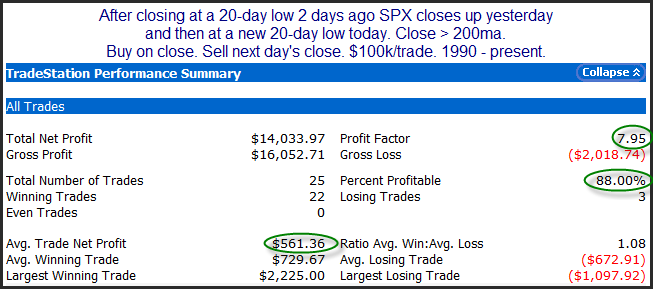
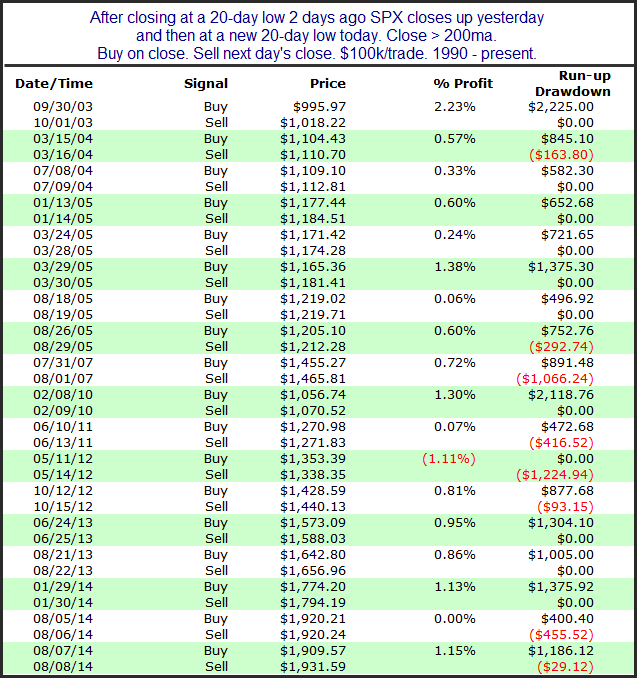
Thursday quickly undercut Tuesday’s closing low and put an end to Wednesday’s bounce attempt. How has the market responded under similar circumstances in the past? For the study below, I look at times when a 20-day low was followed by a 1-day bounce and then another 20-day low (when above the 200ma).

2014-09-26 image1

The numbers here look very solid and suggest a bullish edge for Friday. In fact, the setup has done especially well in recent instances. Below I listed the last 18 trades.

2014-09-26 image2

17 of 18 winners is quite the streak.  I will also note that the stats have been substantially less impressive when SPX has been below its 200ma. This edge has only been prevalent during long-term uptrends.


Want research like this delivered directly to your inbox on a timely basis? Sign up for the Quantifiable Edges Email List.
Sell Rosh Hashana and Buy Yom Kippur?

There is an old Wall St. adage that suggests “Sell Rosh Hashana. Buy Yom Kippur.” It implies that between those two holidays that the market often struggles. I looked back to 1998. First, a quick look at the general numbers. (Note – if either holiday was on a weekend then the Friday before was bought or sold.)

2014-09-25 image1

At first glance there appears to be a solid bearish tendency. But the total loss appears to be thanks to primarily 1 instance. Here is a look at all the trades.

2014-09-25 image2

2008 was the big standout here. I wondered what a profit curve might look like without 2008 included. Here is that.

2014-09-25 image3

Very choppy and it has gone effectively nowhere.

Overall, my impression is that there may be some truth to the adage. But the dates are variable. They often fall during times in which there is weak seasonality (like the Weakest Week – this week). So I don’t think there is a reliable trade here, but perhaps the potential weakness is worth keeping in mind.


Want research like this delivered directly to your inbox on a timely basis? Sign up for the Quantifiable Edges Email List.
SPY After Strong Closes For Weak Gains

I’ve seen a few bullish studies in the last few days, but the study below is one with potentially bearish implications for Friday. It is one I have shown a number of times in the past. It shows that when SPY closes strong (in the top 10% of its range) but still only manages a small gain on the day, that the next day has exhibited a downside tendency. Stats are updated..

2014-09-12 image1

Good luck trading today, and have a great weekend!


Want research like this delivered directly to your inbox on a timely basis? Sign up for the Quantifiable Edges Email List.
Possible Implications Of SPY Gap & Reverse Patterns The Last Two Days

Thursday saw the market gap up but reverse and close lower. Friday we had the opposite occur, with SPY gapping down but closing higher. It also closed at a new high on Friday, which triggered the study below.

2014-09-08 image1

The numbers here are somewhat bearish, with much of the damage being done by day 2. Traders may want to give this study some consideration when evaluating the market’s prospects over the next day or two.


Want research like this delivered directly to your inbox on a timely basis? Sign up for the Quantifiable Edges Email List.
Does Wednesday’s Big NDX Drop Hurt The Bull Case?

One interesting aspect of Wednesday’s action was that the NDX suffered its worst decline in at least 20 days while SPX made a 20-day intraday high. This is something I’ve looked at for subscribers in the past, but never shown on the blog. When I previously examined other instances I found little in terms of short-term implications, but the intermediate-term implications appeared strong. Below are updated results.

2014-09-04 image1

Results here appear pretty strong throughout. The big NDX drop during an intermediate-term move higher for SPX has rarely derailed the rally. Most of the time it has been followed by additional gains.


Want research like this delivered directly to your inbox on a timely basis? Sign up for the Quantifiable Edges Email List.
Labor Day Week When The Market Has Been Strong

In past years I have shown that Labor Day week performance has often been poor when the market has rallied over the month (20 trading days) leading up to it. Below is a look at Labor Day week performance when the previous 4-week period has seen gains.

2014-09-02 image1

This shows the poor performance record when there has been a rise in the market. Below is a look at the profit curve using a 4-day exit strategy.

2014-09-02 image2

Definitely choppy. And the last couple of instances have seen gains during the week of Labor Day. But the overall downslope and evidence still has believing it is worth some consideration. (A strongly bullish performance this year could change my mind for the future, though.)


Want research like this delivered directly to your inbox on a timely basis? Sign up for the Quantifiable Edges Email List.

Performance After 2 Unfilled Up Gaps & A 50-Day High

One interesting aspect of Tuesday’s action is the SPY gapped up above Monday’s close, and never filled that gap. This made the 2nd day in a row with an unfilled up gap. The study below is one I’ve shown before in the subscriber letter. It examined other times SPY left 2 unfilled up gaps and closed at a 50-day high. All stats are updated.

2014-08-27 image1

The size of the follow-through isn’t terribly large, but it has been very consistent that some follow through was achieved in the next few days.


Related Quantifiable Edges Studies

Want research like this delivered directly to your inbox on a timely basis? Sign up for the Quantifiable Edges Email List.